Onewheel or electric unicycle? Compare stance, speed, range, terrain and safety to choose the self-balancing ride that fits how far and how you like to ride.
Electric unicycle vs Onewheel is one of the most common questions we hear from riders who have outgrown scooters and want something more compact. Both are self-balancing, single-wheel vehicles controlled by leaning, and both take some practice. But they are built around very different riding positions, and that shapes everything from range to safety gear. Here’s a plain-English comparison for US riders.
Electric unicycle vs Onewheel at a glance
- Stance: on a Onewheel you stand sideways, like on a skateboard or snowboard. On an EUC you face forward with one foot on each side of the wheel.
- Controls: both are ridden by leaning. On a Onewheel you press the nose or tail; on an EUC you lean your whole body forward or back and steer with your hips and shoulders.
- Speed: current Onewheel models are listed at 16 to 25 mph. EUCs range from about 15 mph on entry-level wheels to 40 mph and beyond on performance models (manufacturer claims).
- Range: Onewheel lists ranges of roughly 6 to 32 miles depending on the model. Large EUCs claim 75 miles or more.
- Feel: a Onewheel is a “board sport” toy that many riders love for carving. An EUC is closer to a transportation tool that also happens to be fun.
How each one rides
A Onewheel puts a single wide tire in the middle of a board. You stand sideways with a footpad on each side of the tire, and a sensor in the front pad tells the board you’re on. Lean toward the nose to go, shift weight to the tail to slow, and carve turns with your toes and heels. If you’ve snowboarded, surfed or skated, the motion will feel familiar.
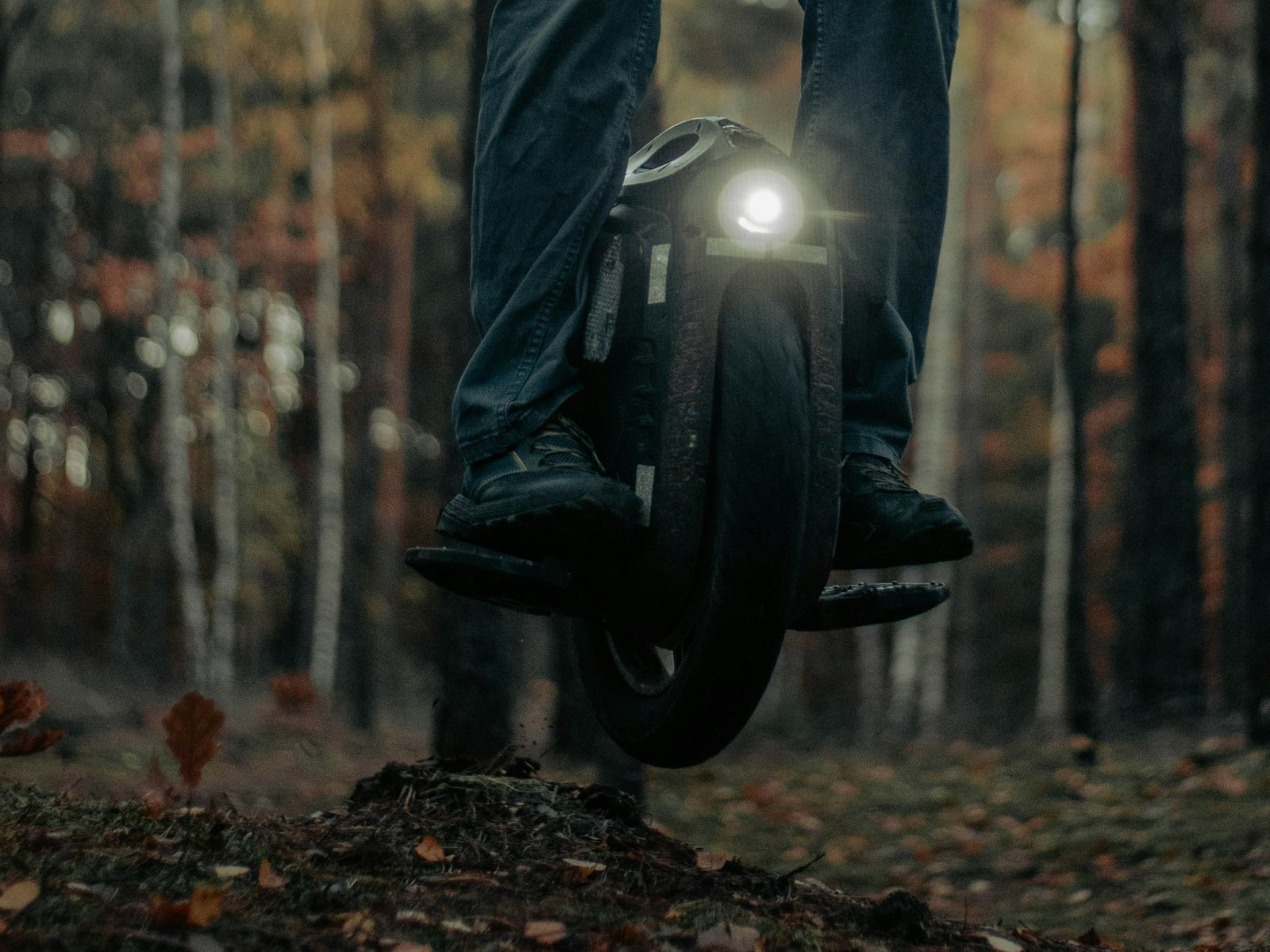
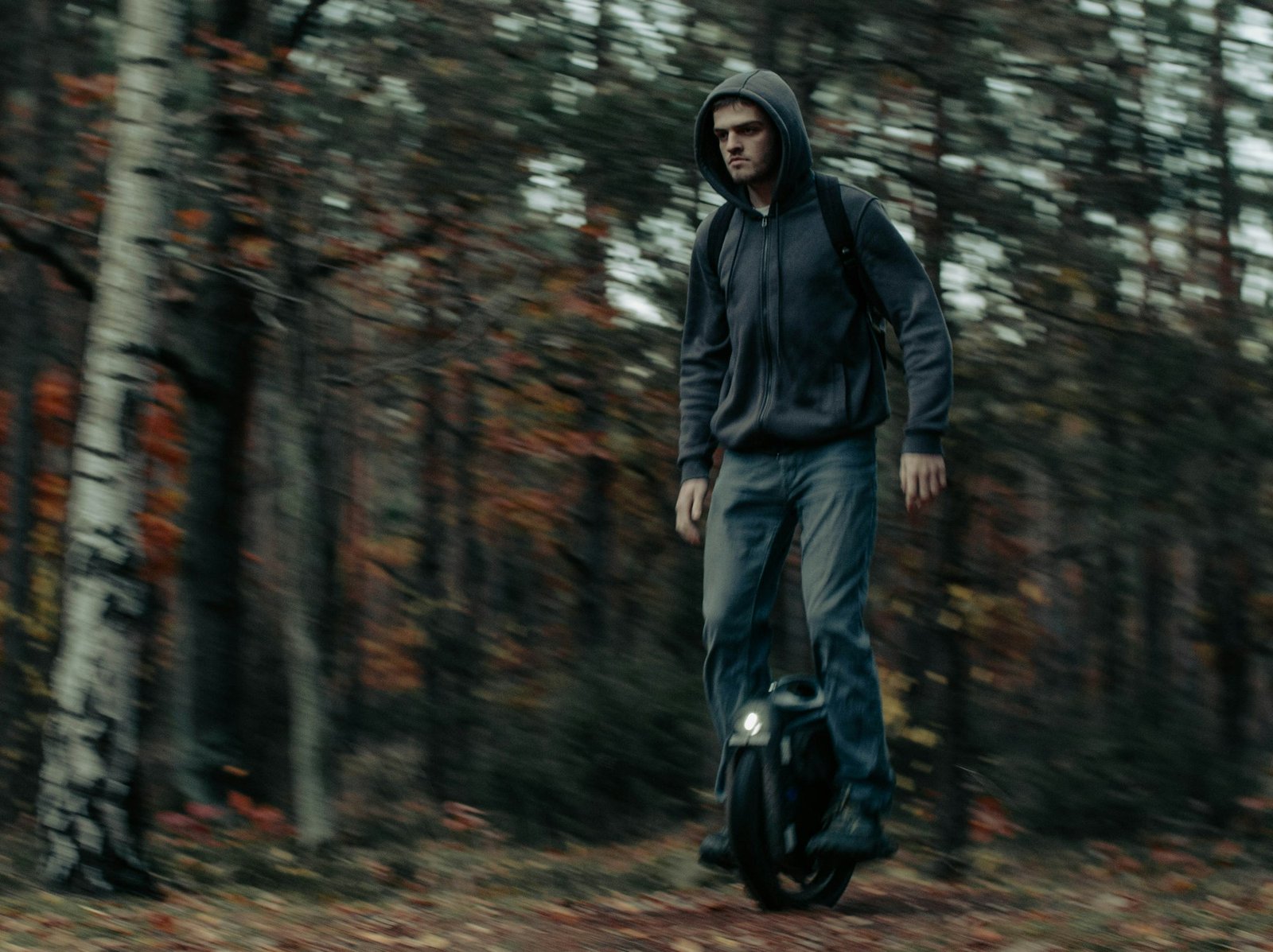
An electric unicycle stands upright. You step onto fold-out pedals on either side of a larger tire, face the direction of travel and grip the shell with your lower legs. You lean forward to accelerate, lean back to brake, and turn by twisting or tilting. Many riders find the forward-facing view and the ability to look straight ahead in traffic make an EUC easier to ride in a city, especially at higher speeds. Our beginner electric unicycles are a good place to start if that sounds like you.
Speed and range: where the gap opens up
This is the biggest practical difference between the two. Future Motion, the company behind Onewheel, currently lists its lineup from the Pint (16 mph, 6 to 8 miles) up to the GT S-Series and Rally XL (25 mph, with listed ranges up to 25 and 28 miles). The longest-range model on the list, the GT, is listed at 20 to 32 miles.
Electric unicycles cover a much wider spread. Using InMotion’s own published specs as an example:
- InMotion V6 (entry level): 15.5 mph (25 km/h) top speed, 18.6 miles of claimed range, 240 Wh battery, 27.6 lb.
- InMotion V12S (high performance): 43.5 mph (70 km/h) top speed, 75 miles of claimed range, 1,440 Wh battery, 90 mm hydraulic suspension, 77 lb.
So a beginner EUC lines up roughly with a mid-range Onewheel, but the EUC category keeps going well past anything a board offers. Because an EUC wraps its shell around the battery, there’s room for very large packs. If your round trip is longer than 15 miles, or you can’t charge at work, that matters. Keep in mind that claimed range is a best-case number; our guide to how far an electric unicycle can really go explains why real-world miles come in lower. Riders chasing distance can browse our long-range electric unicycles.
Terrain and comfort
Onewheels have a reputation for handling grass, dirt paths and beach-side trails, thanks to their wide, low-pressure tire and low center of gravity. That’s a big part of their appeal as a weekend toy.
EUCs approach rough ground differently. Riders keep their knees bent, so their legs work as natural shock absorbers, and many mid-size and large wheels add real suspension, like the V12S’s 90 mm hydraulic setup. Combined with taller tires, that makes suspension EUCs comfortable on broken pavement and capable on trails. See our off-road electric unicycles for wheels built for that kind of riding.
Safety: both have limits you need to respect
Any self-balancing vehicle can only keep you upright while its motor has power to spare. Push past that limit and it can stop balancing.
That risk became front-page news for Onewheel. On September 29, 2023, the US Consumer Product Safety Commission (CPSC) announced a recall of about 300,000 Onewheel boards, including the original Onewheel, Onewheel+, +XR, Pint, Pint X and GT. The CPSC said the boards “can stop balancing the rider if the boards’ limits are exceeded,” and reported four deaths between 2019 and 2021, all from head trauma, with at least three riders not wearing helmets. The remedy for newer models was a firmware update adding “Haptic Buzz,” a tactile and audible warning when riders approach the limit.
EUCs face the same physics. Most wheels warn you with beeps and “tilt-back,” where the pedals tip up to slow you down, as you approach their limits. The lessons apply to both:
- Always wear a certified helmet. Wrist guards and knee pads are worth it too, since falls usually happen forward.
- Learn your vehicle’s warnings and never ignore them.
- Avoid hard acceleration on steep hills or with a low battery, when there’s less power in reserve.
- Charge safely. Our electric unicycle battery safety guide covers charging habits and recalls.
Portability and everyday use
Onewheels are long and flat, so you carry them by a handle or under your arm, and they can ride in a car trunk or lean in a corner. Smaller EUCs are compact and upright, with a carry handle or a telescoping trolley handle on many models, so you can roll them through a store or a station like a carry-on bag. They fit under a desk or between your feet on a bus.
Weight climbs fast with bigger EUCs, though. A 77 lb performance wheel is a different proposition from a 27 lb commuter, so be honest about how often you’ll carry it up stairs.
Local rules are another practical point. Neither device is named in many state and city codes, so riders often need to check how their area treats them. Our article are electric unicycles legal in the US? explains what to look for.
Which one should you buy?
A Onewheel may suit you if:
- You come from skateboarding, snowboarding or surfing and want that sideways, carving feel.
- Your rides are short and recreational, such as park loops or beach paths.
- You don’t need more than about 20 mph or 20-plus miles per charge.
An electric unicycle may suit you if:
- You want to commute or cover longer distances on one charge.
- You prefer facing forward and seeing traffic head-on.
- You want room to grow, from an entry-level wheel to a suspension or performance model, as your skills improve.
Not sure which wheel fits your riding? Take our wheel-finder quiz, line up models with the EUC comparison tool, or browse the full electric unicycle shop.
Frequently asked questions
Is an electric unicycle harder to learn than a Onewheel?
Both take practice. Board-sport riders often pick up a Onewheel faster because the stance is familiar, while an EUC usually takes several sessions to balance side to side. Once learned, many riders find an EUC more relaxed for long rides.
Which is faster, a Onewheel or an electric unicycle?
Current Onewheel models are listed at 16 to 25 mph. Entry-level EUCs are similar, but performance EUCs claim 40 mph or more, so the fastest EUCs are well ahead.
Which goes farther on a charge?
Onewheel’s listed ranges run from about 6 to 32 miles. Large EUCs carry much bigger batteries; InMotion claims 75 miles for its V12S.
Was the Onewheel recalled?
Yes. In September 2023 the CPSC announced a recall of about 300,000 Onewheel boards over a crash hazard. Newer models received a firmware update with a warning feature; owners should follow the recall instructions on the CPSC notice.
Sources
Feature photo: Unsplash.