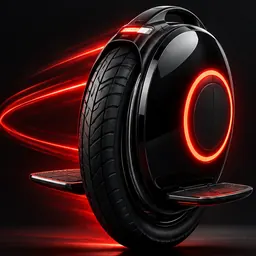

What 84V, 100V, 126V, 134V and 151V really mean on an electric unicycle, what higher voltage gets you, what it doesn't, and how to pick the right class.
Spec sheets for electric unicycles (EUCs) lead with numbers like 84V, 100V, 126V, 134V and 151V. If you are shopping for your first wheel or thinking about an upgrade, it helps to know what those numbers actually mean. This guide explains electric unicycle voltage in plain language: where the numbers come from, what higher EUC battery voltage does for you, what it doesn’t do, and how to choose the right voltage class for the way you ride.
Where EUC voltage numbers come from
An EUC battery pack is built from many small lithium-ion cells, usually cylindrical 18650 or 21700 cells. Cells are connected in two ways:
- In series (the “S” number): voltages add up. More cells in series means a higher pack voltage.
- In parallel (the “P” number): capacity adds up. More parallel groups means more watt-hours (Wh) and more range, without changing the voltage.
According to Battery University, common lithium-ion chemistries used in EVs and e-mobility (NMC and NCA) have a nominal voltage of about 3.6V per cell and are charged to about 4.2V per cell. The big number printed on an EUC spec sheet is almost always the fully charged voltage: cells in series multiplied by 4.2V.
You can see this on InMotion’s own spec page for the V14 Pro, which lists a “32S4P” battery made of Samsung 21700 cells and a 134.4V pack voltage. That’s 32 cells in series × 4.2V = 134.4V, with four parallel groups adding capacity (2,400 Wh, per InMotion).
Common electric unicycle voltage classes
Here is how the voltage classes you’ll see today line up. Nominal voltage is the average the pack sits at during a ride (cells × 3.6V); the headline figure is the fully charged voltage (cells × 4.2V).
- 67V (16S): nominal about 58V. An older standard still found on some smaller and earlier wheels.
- 84V (20S): nominal 72V. A long-time standard for mid-size wheels.
- 100V (24S): full charge 100.8V, nominal about 86V. Common on mid-range wheels such as the InMotion V12.
- 126V (30S): nominal 108V. Used on many high-performance and suspension wheels.
- 134V (32S): full charge 134.4V, nominal about 115V.
- 151V (36S): full charge 151.2V, nominal about 130V. The highest voltage class in this list, found on flagship performance wheels such as the LeaperKim Lynx.
A few real-world examples, using manufacturer or retailer-listed specs: the InMotion V12 is listed at 100V with a 1,750 Wh battery; the KingSong S22 Pro at 126V and 2,220 Wh; the InMotion V14 at 134V and 2,400 Wh; and the LeaperKim (Veteran) Lynx with a 2,700 Wh, 151V pack. Our compare tool makes it easy to line wheels up side by side.
What higher voltage does for you
An electric motor’s maximum speed rises with the voltage you feed it, and power equals voltage multiplied by current. Raising voltage therefore helps in a few ways:
- Higher top speed. With a similar motor, a higher-voltage wheel can spin faster before it runs out of headroom. That’s a big reason flagship performance wheels have moved to 126V and above.
- More safety margin. An EUC balances you by constantly pushing the motor forward or back. It needs spare power for hard acceleration, braking and bumps. eWheels sums it up: higher-voltage motors “are capable of higher speeds with better brown-out safety margins.” A brown-out (or cutout) is when the wheel can’t deliver the power needed to keep you upright.
- Less current for the same power. Because power is voltage × current, a higher-voltage system can deliver the same power with less current, which generally means less heat in wiring and electronics.
Manufacturers’ top-speed figures are claims made under ideal conditions; real speed depends on rider weight, terrain, temperature, tire pressure and charge level.
What voltage doesn’t tell you
Voltage is only one line on the spec sheet. It does not, on its own, tell you:
- Range. Range depends mostly on battery capacity in watt-hours (Wh), plus your weight, speed and terrain. A 100V wheel with a big pack can out-range a 134V wheel with a small one.
- Torque and hill climbing. Motor design matters. Some models come in “high-speed” and “high-torque” motor versions at the same voltage, trading top speed for climbing pull.
- Weight and size. Higher-voltage wheels need more cells, so they are usually bigger and heavier. That matters if you carry your wheel up stairs or onto a train.
- Whether it suits a beginner. A 151V wheel isn’t harder to ride slowly, but it is heavier and more powerful than most new riders need.
Why your speed changes as the battery drains
Battery University gives a typical working range of about 3.0–4.2V per lithium-ion cell. As you ride, pack voltage drops. On a 30S (126V) wheel, for example, the pack falls from 126V toward roughly 90V near empty. Voltage also sags briefly under heavy load, such as hard acceleration up a hill.
Because available speed depends on voltage, an EUC has less headroom at low charge. Wheels handle this with speed warnings (beeps) and tilt-back, where the pedals tip up to slow you down. Treat those warnings seriously, especially when your battery is low; that’s when pushing hard is most likely to end in a cutout.
Chargers and voltage: match them exactly
An EUC charger must be designed for your wheel’s pack voltage. A 100V wheel needs a charger that outputs 100.8V, a 126V wheel needs 126V, and so on. Never use a charger meant for a different voltage, and stick with the charger supplied or approved by the manufacturer. Higher-voltage packs also hold more energy, so the usual lithium-ion habits matter: charge on a hard surface, stay nearby, and stop using a battery that is damaged, swollen or smells unusual. Our guide to electric unicycle battery safety covers charging habits and recalls in more detail.
Voltage also matters if you travel: airline rules for lithium batteries are based on watt-hours, and EUC packs are far above the limit. See can you fly with an electric unicycle for the details.
Which EUC voltage is right for you?
Think about how you ride rather than chasing the biggest number:
- Learning or short trips: an 84V or 100V wheel is lighter, easier to handle and usually plenty fast. Browse our beginner electric unicycles.
- Daily commuting: 100V or 126V hits a sweet spot of speed, safety margin and manageable weight. See commuter wheels.
- Experienced riders, off-road and long fast rides: 126V, 134V and 151V wheels offer the most headroom and usually the biggest batteries. Check our performance and suspension categories.
Not sure where you fit? Take the wheel-finder quiz or read our EUC buying guide.
Frequently asked questions
Is a higher-voltage electric unicycle always faster?
Usually, but not always. Motor winding, controller tuning and the manufacturer’s speed limits all play a part. Compare the claimed top speed and motor version, not just the voltage.
Does higher voltage mean more range?
Not by itself. Range follows battery capacity in watt-hours. Higher-voltage wheels often have larger packs, which is why they tend to go farther, but the voltage isn’t the reason.
What does “32S4P” mean?
32 cells connected in series (setting the voltage: 32 × 4.2V = 134.4V when full) and four of those strings in parallel (adding capacity).
Can I upgrade my wheel to a higher voltage?
No. The motor, controller, charger and battery management system are all designed for one voltage. Changing it is unsafe and is not supported by manufacturers.
Sources
- Battery University: BU-205 Types of Lithium-ion (updated December 8, 2023)
- InMotion: V14 Pro product and specifications page (accessed October 2, 2026)
- eWheels: Choosing an electric unicycle with the right battery pack for you (March 8, 2021)
- ERideHero: InMotion V12 specifications (accessed October 2, 2026)
- ERideHero: KingSong S22 Pro specifications (accessed October 2, 2026)
- ERideHero: InMotion V14 specifications (accessed October 2, 2026)
- eWheels: Veteran Lynx 2,700 Wh specifications (accessed October 2, 2026)
Feature photo: Unsplash.